

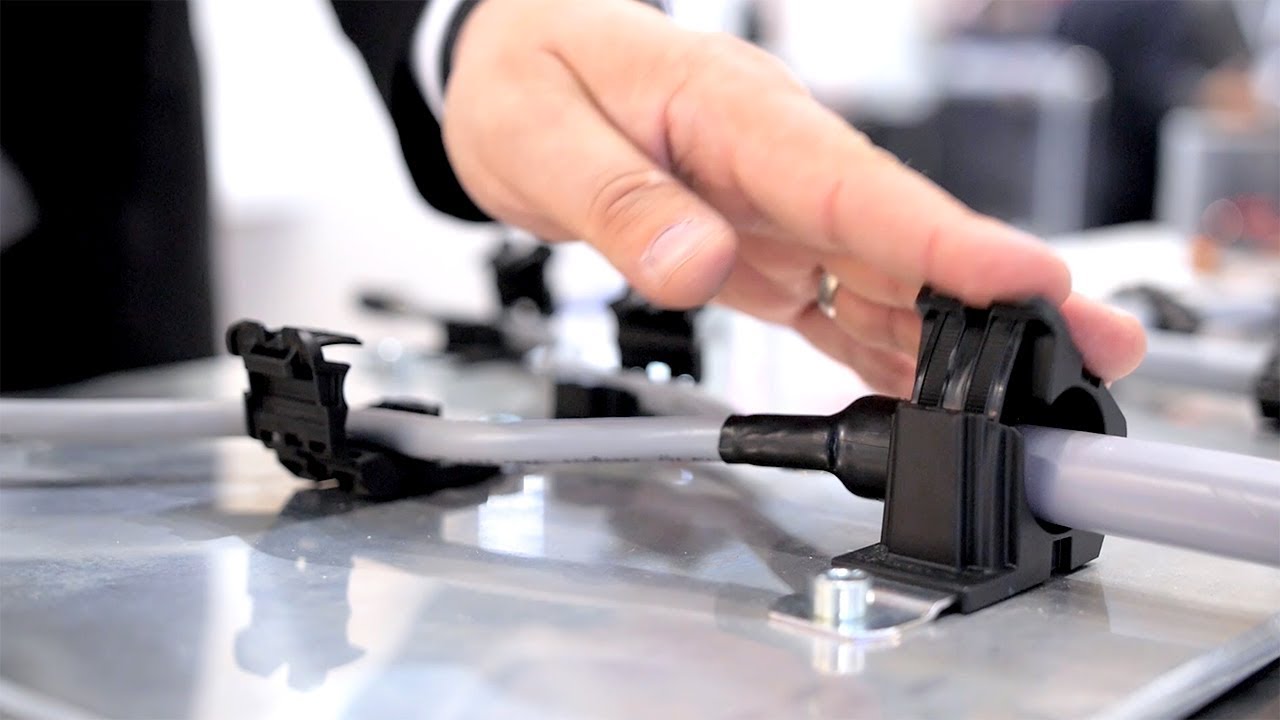
Most hose and cable failures don’t start with bad hose or bad cable. They start with the wrong support. Small myths about P-clamps turn into sagging runs and chafed jackets that cost real downtime.
All P-clamps are not the same
Walk through any maintenance aisle and the bins don’t tell the full story. Black plastic and silver metal loops can look interchangeable at a glance. They aren’t. Body material determines where a clamp can be used and how long it lasts there. The bins alone reveal little about resistance to sun or washdown.
Nylon bodies are light and don’t rust in the usual sense, but heat and sunlight still matter. A nylon loop that is fine beside a cool air line can soften near a hot manifold or go chalky after long sun exposure if the grade is not stabilized for it. Zinc-plated steel feels tougher in the hand, yet the plating is thin. Once a screwdriver scratches it or damp air gets under an edge, red rust spreads fast. Stainless options handle damp and washdown far better, but even there the grade and finish have to suit the actual chemistry and temperature. There’s no universal safe choice.
Price tags don’t show any of that. A cheap clamp can look right on the bench and still be wrong for the bay it goes into. Maker data sheets list temperature limits and load limits for a reason. Match those numbers to the conditions where the clamp will sit. Budget alone won’t tell whether it’s suitable.
Coastal air and pool sheds punish the wrong pick fast. A plated loop that survives a dry store can streak in weeks near salt haze. When there’s doubt, choose a more resistant body and keep the liner suited to damp use. Maker sheets are more useful than habit here.
Size and tightness myths damage hose and cable
Two installation errors show up again and again. Either the bore is wrong or the screw is too tight.
Inside diameter has to fit the outside of the line with the liner in place. Too small and a soft hose ovals and flow drops while the jacket takes a set it won’t recover from. Too large and the line slides with every pulse and rubs a flat spot that later cracks. The fix is simple on paper. Use the maker’s finished bore size with liner fitted. Allow room for expansion and vibration while accounting for bend radius and anchor load.
Cranking the screw down can cause damage even when it feels secure. Excess torque crushes suction hose and deforms cable insulation. It can also crack a polymer body in cold shops. Stripped threads then leave a clamp that looks fixed but isn’t holding properly.
Torque specs come from the maker for the exact clamp and mount. They change with body type and screw size, so guessing by feel won’t hold across a plant. A P-clamp holds the line in place. It doesn’t seal a pressurized joint, and it won’t fix wrong bore size or wrong system pressure. Any check or rework on a live run needs a qualified tech to assess isolation and stored energy first.
Rubber liners are not optional padding
Take the liner out and metal meets jacket with no give. Every start-up shake then becomes another wear cycle at that contact point.
EPDM inserts cushion the line and spread clamp load over more area. That spread stops a hard edge from biting into hose cover or cable sheath. The liner also breaks metal-to-metal contact that can start galvanic corrosion in damp spots. Compatibility still matters. EPDM suits many water and washdown mixes, yet oils and high heat call for a different choice, so the maker’s chemical and temperature notes decide.
Don’t stack tape or extra rubber to make a loose clamp fit. Packing changes the finished size in ways the maker did not test. Order the lined size that is built for the measured outside diameter.
Measure the line itself rather than the liner. Makers list the finished bore size with liner fitted, and that number is the one to use when selecting a clamp.
Fretting starts small. A line that can shuffle a millimeter in its loop saws at the same spot through thousands of cycles. Liners break that cycle by gripping gently and damping vibration. Hard clamping on bare metal can’t do the same without damage.
Indoor location does not remove corrosion or spacing rules
A roof doesn’t keep every source of moisture away from clamps. Condensation forms on cool steel at night and washdown spray drifts farther than expected. Scratches from installation tools break thin plating and open a path for damp air. Humidity near wash bays and chemical totes does the rest. Zinc-plated loops often show the first orange freckles there, while plain hardware nearby follows.
That doesn’t mean every indoor clamp has to be stainless. It means the choice has to fit the zone. Dry and clean office runs do well with nylon or plated steel when the maker rates them for the load and heat. Damp or chemical zones need a body and liner rated for that mix, with maker data guiding the choice.
Spacing fails the same quiet way. A run with one clamp at each end looks tidy on day one. Middle spans then sag between points and bounce with fans and pumps. Terminations take that movement as a steady tug. Electrical rules in most areas call for close support near boxes and short runs between points, and harness practice calls for planned intervals for the same reason. The local wiring rules and the clamp maker’s load and span notes guide spacing for the job.
Sag always finds the weak point.
Vertical drops add pull. Gravity loads every mount below, so top clamps carry more than mid clamps. Weak mounts creep and let the line slide down. Anchors rated for the weight and checked for wall grip stop that slide.
What steady support actually calls for
Good support comes down to matching material and finished size against maker sheets. This is why many shops standardize on quality P CLAMPS with the right body and liner for each zone instead of mixing leftovers.
Start with the environment along the route. Note heat and moisture for the exact path. Note any chemical splash nearby, then pick a body the maker rates for it. Size to the line’s outside diameter using the finished number, not a guess. Check mount strength for vertical drops and heavy fills, and keep bend radius easy near anchors.
Source a broad range so odd diameters don’t force a wrong fit. Keep a few lined and unlined choices on hand for service work. Records give the next tech something more reliable than memory when identifying what was used.
Zip ties are not a permanent swap
Cable ties have a place. They can stage a harness or tame a short tail, but permanent support asks more of the fixing. Generic ties relax with heat cycles and turn brittle with long sun exposure, then the loop opens at the worst time.
Some ties are rated for specific lasting uses. Those ratings name the material and load for a narrow scope. That scope still has to match code and maker limits for load and temperature in the setting. A tie that is fine inside a panel may not pass as fixed support along an open run. Don’t assume. Read the tie’s sheet as carefully as the clamp’s sheet.
Ties also pinch at one thin line. P-clamps spread load through a band and liner. That spread is why vibration loosens ties first.
Harness routing shows the difference. Planned harness runs use evenly spaced clamps that hold shape through heat and vibration. Ties pulled tight at odd gaps let branches drift and rub. Clamps keep the routing in place.
Electrical cable needs clamp support too
There’s a habit of saving P-clamps for water and air. Power and signal cables get left to hang. Hanging cable still moves. It rubs on tray edges and studs until insulation thins.
Support keeps bends easy and takes weight off lugs and terminals. A tight bend at a box cracks sheath over time. A long drop pulls on the very screws that should stay snug. Planned clamps stop both. Route with harness logic, keeping even gaps and no pull at the ends.
Inspectors look for this. Loose and unsupported cable reads as unfinished work and can fail sign-off. Fixed and spaced support reads as planned work. Local wiring rules govern fixing and support in each area.
Mixed runs need thought. Air and power can share a path when each keeps its own clamp and gap. Don’t cinch different lines in one loop to save a screw. Movement rates differ and jackets wear.
Heat and chemicals narrow the material choice
Nylon and steel behave differently when heat climbs. What holds at room temperature may sag near boilers and exhausts.
Nylon grades carry a rated ceiling. Near that ceiling stiffness drops and creep starts, and solvents can swell some grades. Don’t guess from color. Black doesn’t prove sun stability and white doesn’t prove chemical resistance. Only the grade sheet with temperature and chemical notes tells if a given loop fits a hot or oily corner.
Stainless handles heat and many wash fluids better. Still, chemistry and heat decide the outcome together. Concentration matters too. A grade that shrugs off one mix may pit in another. Salt spray is not the same test as acid splash. Check the maker’s rating for the exact fluid and heat before standardizing.
Don’t change bore size or system pressure to dodge a heat issue. Flow and load shift in ways that need design review. Pick the clamp for the system as built.
When sheets disagree, field history helps. Talk to the maker about prior installations in the same wash mix and heat band. Notes from those jobs offer more to work with than guesses.
P-clamps look simple until a line sags or chafes through. Material and finished size have to suit the actual location and line. Torque has to follow the maker’s sheet, with liners and spacing doing the quiet work that keeps runs still. Get those choices right and support stops being the failure point.
